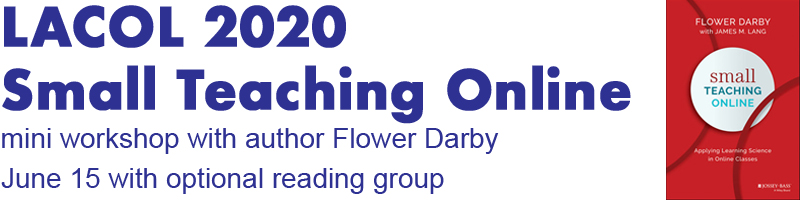
Webinar: Small Teaching Online with author Flower Darby Date and Time: June 15, 11:00am – 12:30pm EST Location: Zoom Registration:REGISTER BEFORE MAY 18th!
Small teaching is a phrase coined by Professor James M. Lang to describe an incremental approach to improving instruction. In 2019, instructional designer Flower Darby and Lang teamed up to apply small teaching principles to the online realm. The result of their collaboration is an essential volume for any educator, “Small Teaching Online: Applying Learning Science in Online Classes“.
As a highlight of the LACOL 2020 virtual workshop, Darby will lead an online mini-workshop, exploring small steps with big impacts for students.
The book recommendation is excellent – a lot of useful suggestions which would take years to figure out.
-Dr. Natalia Toporikova, Washington and Lee University, biology professor and online data science instructor, summer 2019, 2020
Establishing presence and social learning through multi-modal engagements and reflective meta-cognition are effective techniques for *any* class, both face-to-face and through the internet. Communicating the underlying what, why and how of learning is especially important for online learning success. And, like any important new skills, acquiring these capabilities takes planning and practice.
Sakai is officially retiring on May 31, 2020. Note that you will NOT have access to any Sakai courses or content after May 31, 2020.
We are now opening up our third and final bulk migration request to move your course and project sites from Sakai into Canvas. Beginning now and continuing through May 4, 2020, you may request to have your course or project sites migrated from Sakai into Canvas by filling out the form available at https://go.wlu.edu/migrate.
At this point we are accepting migration requests for ANY needed course or project sites from ANY term. Courses will be ready in Canvas by May 18, 2020. You will be notified when your courses are available. This will give you time to check the final migrations for accuracy and completeness by the May 31, 2020 deadline.
Note that you will not have access to any Sakai courses or content after May 31, 2020. All materials you wish to save from Sakai need to be downloaded to your own computer or migrated into Canvas by that time.
Please contact Brandon or Helen directly (bucyb@wlu.edu or x8651; hmacdermott@wlu.edu or x4561) or via help@wlu.edu to ask any Canvas questions or to request personal training.
We apologize for asking you to do one more thing during this unprecedented time of virtual instruction here at W&L, but rest assured there will be only a few more emails related to the Sakai-Canvas migration, as our year-long process finally comes to a close at the end of May.
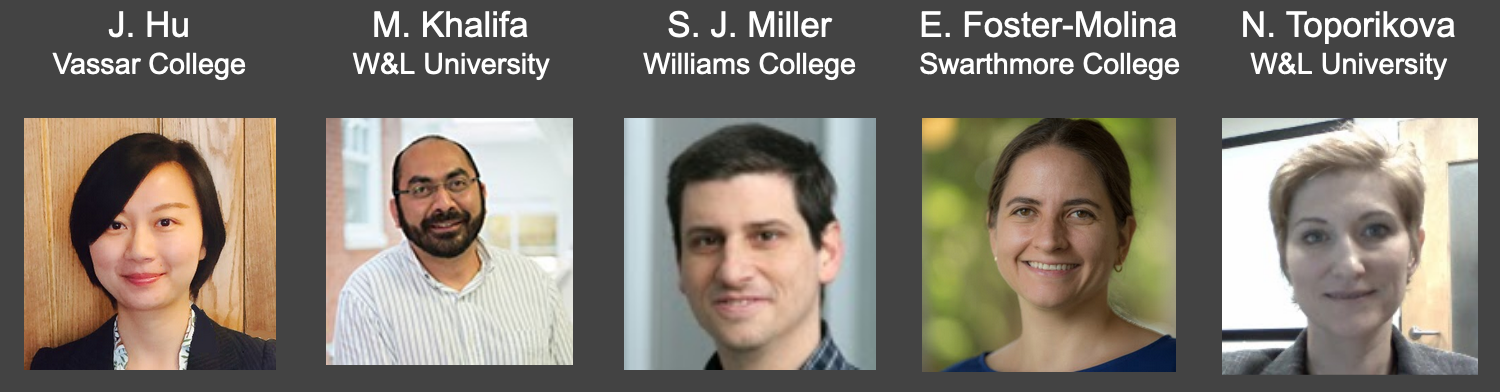
Join a live LACOL webinar and hands-on practice with five experienced liberal arts teachers from Swarthmore College, Vassar College, Williams College, and Washington and Lee University. This team regularly collaborates to deliver online/hybrid classes for the liberal arts.
Many liberal arts colleges are asking faculty to consider how they may temporarily move their teaching online as part of emergency preparedness in the face of COVID-19 or other disruptions to regular classroom teaching. Tips and guides are circulating, and faculty get lots of support from their local IT and teaching and learning centers.
This interactive Zoom session will highlight five liberal arts colleagues (including our very own Moataz Khalifa, Assistant Professor and Director of Data Education, and Assistant Professor of Biology, Natalia Toporikova!) to explore the ways they’ve learned to teach effectively online while maintaining a liberal arts approach that emphasizes personal interactions and critical thinking. Bring your ideas and questions!
Webinar Hosts
Two live sessions:
Tuesday, March 17, 2020 – 1:00pm-2:00pm EST
Thursday, March 19, 2020 – 11:00am-12:00pm EST
Recordings will be shared afterwards.
Webinar Agenda:
Min 00 – 10: Welcome and Self-Introductions
Learning goals for this session
A little background about the LACOL summer online class
Min 10 – 35: Hands-on practice in Zoom
Encouraging Student Participation
Sharing Screens / Remote Screen Control
Using the Chat panel for conversations
Breakouts – great for small group work and discussion
Min 35 – 45: Group reflections on keeping a liberal arts approach online that emphasizes personal interactions and critical thinking
Two bullet surveillance cameras attached on wall. Photo by Scott Webb on Unsplash.
Is tracking college students everywhere they go on campus the new normal? According to this recent Wall Street Journal article by Doug Belkin, “Universities are recording students’ faces with video surveillance cameras, tracking their movements with GPS and monitoring their messages on social media and email. They are detailing students’ study habits through digital textbooks, recording when they enter buildings, logging their presence in class, the library and even the football game. All of these relatively new tracking technologies are in addition to years-old systems that leverage students’ IDs to monitor how frequently individuals are entering gyms, dorms and cafeterias.“
Before you even have to ask, ITS can openly assure all students, faculty, and staff that absolutely no monitoring or surveillance of any kind takes place here at Washington and Lee currently and never will.
Protecting the University’s systems and information assets is tantamount to safeguarding the personal information of students and employees. And privacy isn’t just about compliance; we also respect your privacy on a humanitarian and ethical level.
Due to the current situation regarding the coronavirus outbreak, many organizations are taking precautions regarding the health and safety of their employees. LinkedIn Learning has recommended topics related to successfully managing change and working remotely.
Here’s a list of LinkedIn Learning courses (you must sign in with your W&L credentials) you can leverage to help in this admittedly crazy climate if you are impacted:
We want our students to have effective communication skills, but, truthfully, designing and assessing these activities in class can be incredibly challenging. So, we want to again offer our heartfelt thanks to Stephen for sharing essential questions and criteria to consider when designing unique speaking assignments, a turn-key model that faculty can build on, and an assessment tool to give student feedback.
Lastly, in case you missed it, here’s a link to all of the super helpful workshop materials (must sign in with W&L credentials) in Box.
Is there a topic or issue you’d like CARPE and Academic Technologies to address in Pedagogy and (not) Pizza? Let us know!
Protect yourself and do your part to help prevent the spread of any viruses!
Keep an eye out for packs of disinfectant wipes in classrooms. Over Feb Break, we took the liberty of wiping down keyboards and mice and are making wipes available so you can continue to sanitize these devices before you use them.
POGIL is an acronym for Process Oriented Guided Inquiry Learning.
As a student-centered instructional approach, in a POGIL classroom, students work in small groups/teams on specially designed activities that follow a learning cycle paradigm of exploration, concept invention, and application, with the instructor acting as a facilitator.
Developed in Chemistry before expanding to fields throughout the disciplines, the POGIL approach has two broad aims: to develop content mastery through student construction of their own understanding, and to develop and improve important process skills such as information processing, communication, critical thinking, problem solving and metacognition and assessment.
Matt Tuchler and Gail Webster
Image 1 of 10
Gail Webster, Professor and Chair of Chemistry at Guilford College, and our very own Matt Tuchler, Associate Professor of Chemistry, acted as the facilitators, leading us though the organization of a POGIL course, how guided inquiry is structured in a POGIL classroom, several POGIL activities, as well as considerations for classroom facilitation.
Attendees who experienced a POGIL-based learning environment included faculty and staff members from Accounting, Biology, Business Administration, Chemistry and Biochemistry, Cognitive and Behavioral Science, Computer Science, ITS, Journalism and Mass Communications, Physics and Engineering, and the University Library.
Many thanks to both Gail and Matt, and all who took the time to attend. We’re always thrilled to offer provide training in new teaching pedagogies and even more elated when faculty are interested and willing to learn to use these methods.
BONUS: Find the Enhancing Learning by Improving Process Skills in STEM (ELIPSS) rubrics helpful? We did, too! View and/or download all the rubrics.
CT = Critical Thinking
IC = Interpersonal Communication
IP = Information Processing
MC = Metacognition
MG = Management
PS = Problem Solving
WC = Written Communication
TW = Teamwork
The files with “feedback” in the title — CT, IC, IP, TW — are those with suggestions for improvement. This new style is not available for all rubrics yet.
Some students are reluctant to embrace active learning methods, Robert Talbert notes, but it’s important to combat misperceptions they might have about them.
He reminds educators that:
learning is a process, not an action performed onto someone;
the absence of lecturing is not the same as having to teach oneself; and
the skill of self-teaching is essential and needs to be developed.