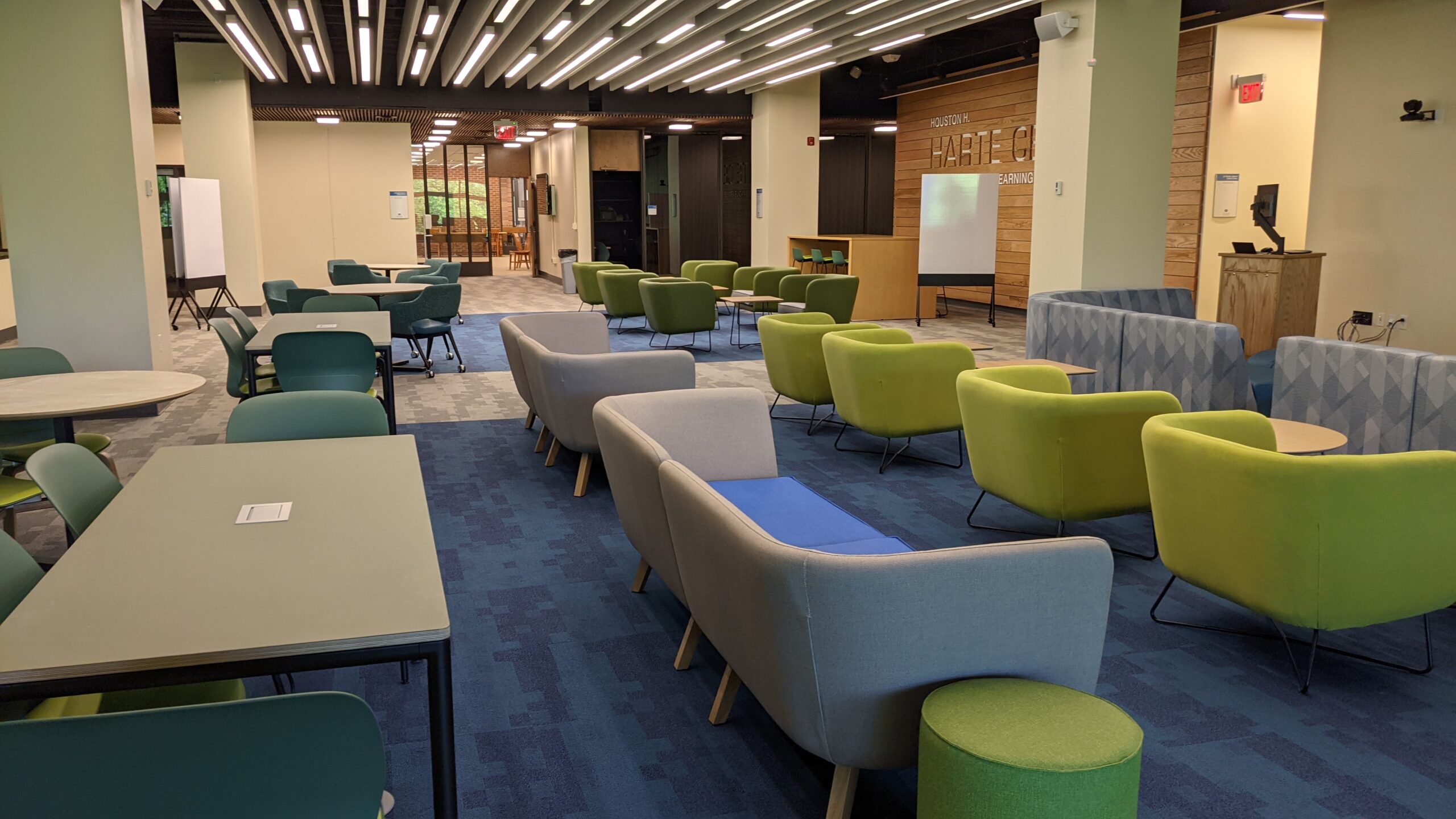
The Harte Center is hosting an informal gathering at the southern end of the Harte Center, every Wednesday from 10-11:00 a.m., through the end of Winter Term.
Feel free to stop by, grab a cup of coffee or tea and some nibbles and hang out and chat. Nothing fancy, just a chance to take a little break in the middle of the week, gather with colleagues and students, and get to know the Harte Center.
This session brings to the table ideas about steps your departments can take to create success in our programs for both students and faculty.
Please join us on Thursday, October 7th at 12:15 pm in Hillel 101 for a conversation about ideas—some fully formed, others still in a nascent stage—developed in Art and Art History, Computer Science, and Chemistry.

Diversity, equity, and inclusion is a central tenant of W&L’s strategic plan.
The University has invested greatly in this effort, including creating a dedicated physical space for a Center for DE&I, allocating $10M in additional funding from the endowment to accelerate this work, and creating programming. W&L’s commitment to DE&I extends to all facets of the University including student life, academics, admissions, employee hiring, faculty recruitment and retention, and Institutional history.
The Harte Center and Academic Technologies are teaming up to host a luncheon series: Departmental Initiatives in DE&I.
If our institutional efforts toward diversity, inclusion, and equity are to be truly impactful, we need to find ways to share effective practices with each other. This series, highlighting departmental and programmatic DEI initiatives, is designed to create conversations about what all of us–every department, every program, every individual–can do to ensure that every student who arrives on our campus has the opportunity to achieve their greatest potential.
The luncheon series begins at the end of the month, highlighting the work of the Geology department.

Looking for Academic Technologies or Harte Center staff? We’ve moved!
You can now find us —
- Senior Academic Technologist Brandon Bucy;
- Associate Director of Assessment Kristy Crickenberger;
- Director of the Harte Center Paul Hanstedt;
- Director of Academic Technologies Julie Knudson;
- Director of Fellowships Matthew Loar;
- Academic Technologist Helen MacDermott, and
- Harte Center Administrative Assistant Brittany Wright
— on the 1st floor of Leyburn Library.
You will ALSO find lots of new, comfortable, and inviting spaces to read, work, or meet with colleagues! And whiteboards galore! 😍😍😍
Please come by to say hello! We’re also reflecting upon and recovering from this past academic year, and preparing to support W&L faculty and staff for a hopefully LESS stressful and chaotic Fall Term.
POGIL is an acronym for Process Oriented Guided Inquiry Learning.
As a student-centered instructional approach, in a POGIL classroom, students work in small groups/teams on specially designed activities that follow a learning cycle paradigm of exploration, concept invention, and application, with the instructor acting as a facilitator.
Developed in Chemistry before expanding to fields throughout the disciplines, the POGIL approach has two broad aims: to develop content mastery through student construction of their own understanding, and to develop and improve important process skills such as information processing, communication, critical thinking, problem solving and metacognition and assessment.
Matt Tuchler and Gail Webster
Gail Webster, Professor and Chair of Chemistry at Guilford College, and our very own Matt Tuchler, Associate Professor of Chemistry, acted as the facilitators, leading us though the organization of a POGIL course, how guided inquiry is structured in a POGIL classroom, several POGIL activities, as well as considerations for classroom facilitation.
Attendees who experienced a POGIL-based learning environment included faculty and staff members from Accounting, Biology, Business Administration, Chemistry and Biochemistry, Cognitive and Behavioral Science, Computer Science, ITS, Journalism and Mass Communications, Physics and Engineering, and the University Library.
Many thanks to both Gail and Matt, and all who took the time to attend. We’re always thrilled to offer provide training in new teaching pedagogies and even more elated when faculty are interested and willing to learn to use these methods.
BONUS: Find the Enhancing Learning by Improving Process Skills in STEM (ELIPSS) rubrics helpful? We did, too! View and/or download all the rubrics.
- CT = Critical Thinking
- IC = Interpersonal Communication
- IP = Information Processing
- MC = Metacognition
|
- MG = Management
- PS = Problem Solving
- WC = Written Communication
- TW = Teamwork
|
The files with “feedback” in the title — CT, IC, IP, TW — are those with suggestions for improvement. This new style is not available for all rubrics yet.
Interested in future pedagogy workshops? Sign up for the Academic Technologies once-per-term newsletter or reach out to Julie Knudson, Director of Academic Technologies, or Paul Hanstedt, Director of the Center for Academic Resources and Pedagogical Excellence (CARPE).
Bummer! It was a great session!
If you’d like to hear about a new approach to teaching lab report writing that will yield more effective lab reports AND deepen student learning of course content, then watch this recording:
[NOTE: You must login with your W&L credentials to view this video.]
Don’t miss this opportunity to hear more about a new approach to teaching lab report writing that will deepen student learning of course content and yield more effective lab reports. A win-win for all!

All of the following events are co-sponsored by the Center for Academic Resources and Pedagogical Excellence (CARPE) and yours truly (Academic Technologies).
| Winter Term
TBD
by
participant
schedules |
OBSERVATION CIRCLES: Developing Our Teaching through Constructive Observation Practices
Curious about how other faculty create dynamic lectures, facilitate effective discussions, or enact powerful active learning? Or trying something new yourself, and looking for thoughtful, confidential feedback?
Observation circles are very simple: faculty are put into teams of three, coordinating a series of visits to each other’s classroom. The goal is to provide each other with confidential, formative feedback on how we can make our classes and our teaching more effective. Previous participants have found Observation Circles to be a stress-free way to improve their work and to deepen collegiality.
Interested? E-mail phanstedt@wlu.edu, subject line “Observation Circles.” Be sure to include your department and your schedule for winter term. |
| Winter Term
Dates: TBD
Location: TBD |
Let’s Start the Conversation: ANTI-RACIST PEDAGOGY READING GROUP
“In a racist society, it is not enough to be non-racist, we must be anti-racist.”—Angela Y. Davis
As educators, we need to ask: what it does it mean to be truly inclusive and where does one start? Anti-racism is continuous work, requiring active seeking and questioning of society and of ourselves, at times leading us to places of discomfort and frustration. However, through that engagement, productive conversation and curricular changes occur that truly promote a more inclusive environment. In this group, we will read and discuss works that engage with anti-racism and connect those messages and methodologies to pedagogy, thereby modeling ways to integrate anti-racism into the classroom and our daily lives. Readings will be manageable lengths (15-20 pages— however the content may take time to digest.
Interested? E-mail Dr. Adrienne Merritt at amerritt@wlu.edu. |
| Winter Term
Dates:
- 1/14/20
- 2/4/20
- 2/18/20
- 3/10/20
- 3/31/20
4:30-6:00 PM
Ruscio Center for Global Learning 123 |
SMALL TEACHING DINNER SEMINAR
What is SMALL TEACHING: EVERYDAY LESSONS FROM THE SCIENCE OF LEARNING? It’s a book by James Lang, a leading voice in the scholarship of teaching and learning, using the best science on classroom techniques to argue that we don’t have to make huge changes in our classes to deepen student learning.
What is the “Small Teaching Seminar”? It’s CARPE’s inaugural dinner/book club, a series of five linked sessions built around a tasty dinner and Lang’s book, designed to allow any professor in any discipline to strengthen long-term learning. Everyone who signs up for the seminar will receive a copy of Lang’s book.
Though we recognize that not all enrollees will be able to attend every session, attendees are encouraged to make space for as many of the dinners as possible, recognizing the power of collaboration and community to strengthen both our learning and our practice.
Interested? Sign up at http://go.wlu.edu/smallteachingseminar |
Wednesday
26 February
8:30 AM –
4:00 PM
Ruscio Center for Global Learning 114 |
POGIL TRAINING SEMINAR—Strengthening Student Learning through a Proven Classroom Approach
POGIL is an acronym for Process Oriented Guided Inquiry Learning. Because POGIL is a student-centered instructional approach, in a typical POGIL classroom or laboratory students work in small teams with the instructor acting as a facilitator. The student teams use specially designed activities that generally follow a learning cycle paradigm. Developed in Chemistry before expanding to fields throughout the disciplines, the POGIL approach has two broad aims: to develop content mastery through student construction of their own understanding, and to develop and improve important learning skills such as information processing, communication, critical thinking, problem solving and metacognition and assessment.
Interested in learning more? Faculty from all disciplines are invited to attend this comprehensive, full-day workshop over winter break led by experienced POGIL facilitator and Professor of Chemistry Gail Webster of Guilford College.
Sign up at http://go.wlu.edu/pogil. |
Tuesday
17 March
4:30-5:30 PM
Northen Auditorium
James G. Leyburn Library |
TEACHING DISTRACTED MINDS—A LECTURE BY JAMES LANG
As faculty struggle with the problem of distracted students on our campuses and in our classes, they have become increasingly frustrated by the ways in which digital devices can interfere with student learning. But are students today more distracted than they were in the past? Has technology reduced their ability to focus and think deeply, as some popular books have argued? Drawing upon scholarship from history, neuroscience, and education, this lecture explores productive new pathways for faculty to understand the distractible nature of the human brain, work with students to moderate the effects of distraction in their learning, and even leverage the distractible nature of our minds for new forms of connected and creative thinking.
James M. Lang is a Professor of English and the Director of the D’Amour Center for Teaching Excellence at Assumption College in Worcester, MA. He is the author of five books, the most recent of which is Small Teaching: Everyday Lessons from the Science of Learning (Jossey-Bass, 2016). Lang writes a monthly column on teaching and learning for The Chronicle of Higher Education and has conducted workshops on teaching for faculty at more than a hundred colleges and universities in the US and abroad.
Interested? Sign up at http://go.wlu.edu/smallteaching |
Wednesday
18 March
8:00-9:30 AM or 12:00-
1:30 PM
Science Addition 202A (8:00 AM) or Hillel House
101
(12:00 PM)
|
SMALL TEACHING: FROM MINOR CHANGES TO MAJOR LEARNING
Research from the learning sciences and from a variety of educational settings suggests that a small number of key principles can improve learning in almost any type of college or university course, from traditional lectures to flipped classrooms. This workshop—offered at two different times and locations—will introduce some of those principles, offer practical suggestions for how they might foster positive change in higher education teaching and learning, and guide faculty participants to consider how these principles might manifest themselves in their current and upcoming courses.
James M. Lang is a Professor of English and the Director of the D’Amour Center for Teaching Excellence at Assumption College in Worcester, MA. He is the author of five books, the most recent of which is Small Teaching: Everyday Lessons from the Science of Learning (Jossey-Bass, 2016). Lang writes a monthly column on teaching and learning for The Chronicle of Higher Education and has conducted workshops on teaching for faculty at more than a hundred colleges and universities in the US and abroad.
Interested? Sign up at http://go.wlu.edu/smallteaching |
Late arrivals and early departures welcome.
Questions? E-mail Dr. Paul Hanstedt at phanstedt@wlu.edu.
Save the Dates!
Top-to-Bottom Course Design Workshop
June 10-12, 2019
Got a new course you’re creating? Or an old course that needs to be refreshed? This workshop is an opportunity to get a jump-start on that process, and to learn from and share ideas with colleagues. Stay tuned for more details!
The Center for Academic Resources and Pedagogical Excellence (CARPE) will be a state-of-the-art Teaching and Learning Center. It will have two primary functions: CARPE will support faculty development towards becoming ever better teachers, through workshops, experimental classrooms, presentations, practice space, and uses of new technology and techniques in teaching; and CARPE will support student learning, through tutoring expertise, a writing and communication center, executive function support, group and individual learning sessions, and uses of new technologies for learning.
Members of the CARPE Task Force discuss the impact that CARPE will have on the campus, including benefits for faculty and students and changes to Leyburn Library. Watch below!