Watch James Lang’s talk about how to boost academic integrity in the age of Al

“We can’t just design around AI because it’s futile: it keeps evolving. Assessment needs to be about the whole relationship you have with students: be transparent, explore variety and encourage reflection.”

Dr. James Lang
Author of Cheating Lessons: Learning from Academic Dishonesty

Missed last week’s webinar about how to curb academic dishonesty in your course? No worries … watch below!

Don’t have time to watch either? That’s okay, here’s a summary!

With regards to academic integrity in the age of artificial intelligence, Dr. Lang emphasizes the importance of maintaining a focus on teaching and creating learning, even while being aware of and attending to academic integrity. He believes that teaching strategies and course design strategies should promote learning while maintaining the standards of academic integrity. He also mentions that these principles were the approach he took in his book “Cheating Lessons”.


Dr. Lang presents his approach to prioritizing learning in the current moment of higher education. He discusses the importance of varying teaching methods, being transparent about course design and expectations, and promoting reflection among students. He believes that these principles are even more important in the age of AI, as AI can perform tasks quickly, but humans have the opportunity to pause, analyze, and reflect on the process


Dr. Lang also discusses a 2023 study where instructors tested six low-effort strategies to reduce academic dishonesty in an introductory programming course (PDF). These strategies included talking about academic integrity at the beginning of the semester, giving a quiz on the topic, allowing students to retract work they had concerns about, reminding students about academic integrity policies throughout the semester, showing tools for success, and reminding students about available help. The study found a significant reduction in similarity scores for assignments after these interventions were implemented.


Dr. Lang advocates for a balanced approach to teaching in the age of AI, where the focus remains on learning and academic integrity. He suggests that educators should not shy away from traditional assignments or teaching strategies due to the capabilities of AI, but rather enhance these assignments with reflection and analysis to promote deeper learning.

“Artificial Intelligence in the Courts” on Thursday, February 15 at 1:00 PM

A robot is sitting at a judge's bench. The text reads, Artificial Intelligence in the Courts, Professor Sarah Cravens. Discussing what lawyers should know about how judges incorporate Al themselves, what they expect from lawyers, and what is on the horizon. Are the robot judges coming? How are recent advances in artificial intelligence tools having an impact in the work of courts in the US and abroad? February 15, 1-2 PM, Moot Court Room, Sydney Lewis Hall, Snacks Provided.

Are the robot judges coming?! 

How are recent advances in artificial intelligence tools having an impact in the work of courts in the US and abroad?

These developments promise improved efficiency and the potential to enhance access to justice, both at individual and systemic levels, but with that potential comes a measure of risk and uncertainty.

Sarah Cravens, Visiting Professor of Law, and  Joshua Fairfield, William D. Bain Family Professor of Law, will explore the upsides and ask whether existing ethics rules are sufficient to cover the issues raised by current use of generative AI by judges (and lawyers) in U.S. courts. They will also discuss what lawyers should know about how judges incorporate AI themselves, what they expect from lawyers, and what is on the horizon.

Thursday, February 15, 2024
1:00 pm – 2:00 pm
Lewis Hall, Moot Court Room

Join us in person or watch via the livestream link.

Update! Improved Email Deliverability with the Qualtrics Emailer

Qualtrics3D illustration of a red mailbox with raised flag and flying envelopes in purple, orange, and white, with a notification bell, against a soft purple background.

Many thanks for your patience as ITS implemented a fix to the Qualtrics emailer yesterday afternoon.

ITS initially set up a Simple Mail Transfer Protocol (SMTP) relay to route emails through our own server. However, the SMTP relay was overwhelmed due to multiple departments sending Fall Term course evaluations simultaneously, causing send failures.

To resolve this, we’ve adopted a more robust approach: we’ve transitioned to using a custom “From” domain within Qualtrics’ own email infrastructure. This change will significantly enhance email deliverability for large-scale survey distributions by utilizing Qualtrics’ superior email handling capabilities.

However, it’s important to recognize the limitations of this new setup. Since the email process is now fully managed by Qualtrics, any issues with email delivery will be outside the scope of ITS. In such cases, direct contact with Qualtrics Support will be necessary for troubleshooting and resolution.

Also, please note that when using the Qualtrics emailer, the default “From” email is survey@wlu.edu. For those who wish to personalize their survey emails, you can change survey@wlu.edu to your own W&L email address. This will NOT impact email deliverability.

If you have any questions or need assistance, contact the ITS Information Desk at help@wlu.edu, 540,458,4357 (HELP), or stop by the Main Level of Leyburn Library.

Free Webinar! “Academic Integrity in the Age of AI”

Higher Learning: How to boost academic integrity in the age of AI. Headshot of James Lang and the Top Hat logo.
 
Dr. James Lang, educator and author of Cheating Lessons: Learning from Academic Dishonesty, will share course design practices that improve student learning while reducing the incentives to cheat.
 
Dr. Lang posits that the root of academic dishonesty often lies in the pressures embedded within the educational system itself. These pressures inadvertently push students towards cheating. What’s compelling is that the strategies to counteract cheating are not just about enforcing stricter rules. Instead, they align closely with principles that cognitive theorists advocate for enhancing student engagement and learning.
 
This approach is not just theoretical. It’s backed by Dr. Lang’s extensive research and experience in education. By rethinking course design and teaching strategies, educators can significantly reduce the incentives and opportunities for students to cheat.
 
This FREE webinar on Thursday, February 1st at 2 pm EST will go over:
 
  • The common course design practices that lead to academic dishonesty
  • Teaching strategies that reduce the incentive and opportunity to cheat
  • How low stakes assessments build confidence and lead to better study decisions
  • The role transparency and motivation play in promoting academic integrity

About the Speaker

James M. Lang, PhD, is the author of six books, including Distracted: Why Students Can’t Focus and What You Can Do About It and Small Teaching: Everyday Lessons from the Science of Learning. He also writes a monthly column on teaching and learning for The Chronicle of Higher Education. A dynamic and highly sought-after public speaker, Lang has delivered conference keynotes and workshops on teaching at more than a hundred colleges, universities, and high schools in the United States and abroad.

Register Now to learn strategies to motivate students and improve learning in the age of AI!

Qualtrics Maintenance Alert for THIS Thursday, January 11th

Illustration of stylized characters interacting with a large computer monitor displaying gears, a magnifying glass, and a paint roller, symbolizing various aspects of maintenance.

We will be conducting a scheduled maintenance on Qualtrics on Thursday, January 11th, from 1-5 pm EST.

To avoid any loss of work, please ensure you have saved all your work and logged out of Qualtrics before 1 pm.

Rest assured, active surveys will remain unaffected.

For assistance, please reach out to the ITS Information Desk at help@wlu.edu, call 540.458.4357 (HELP), or stop by the Main Level of Leyburn Library.

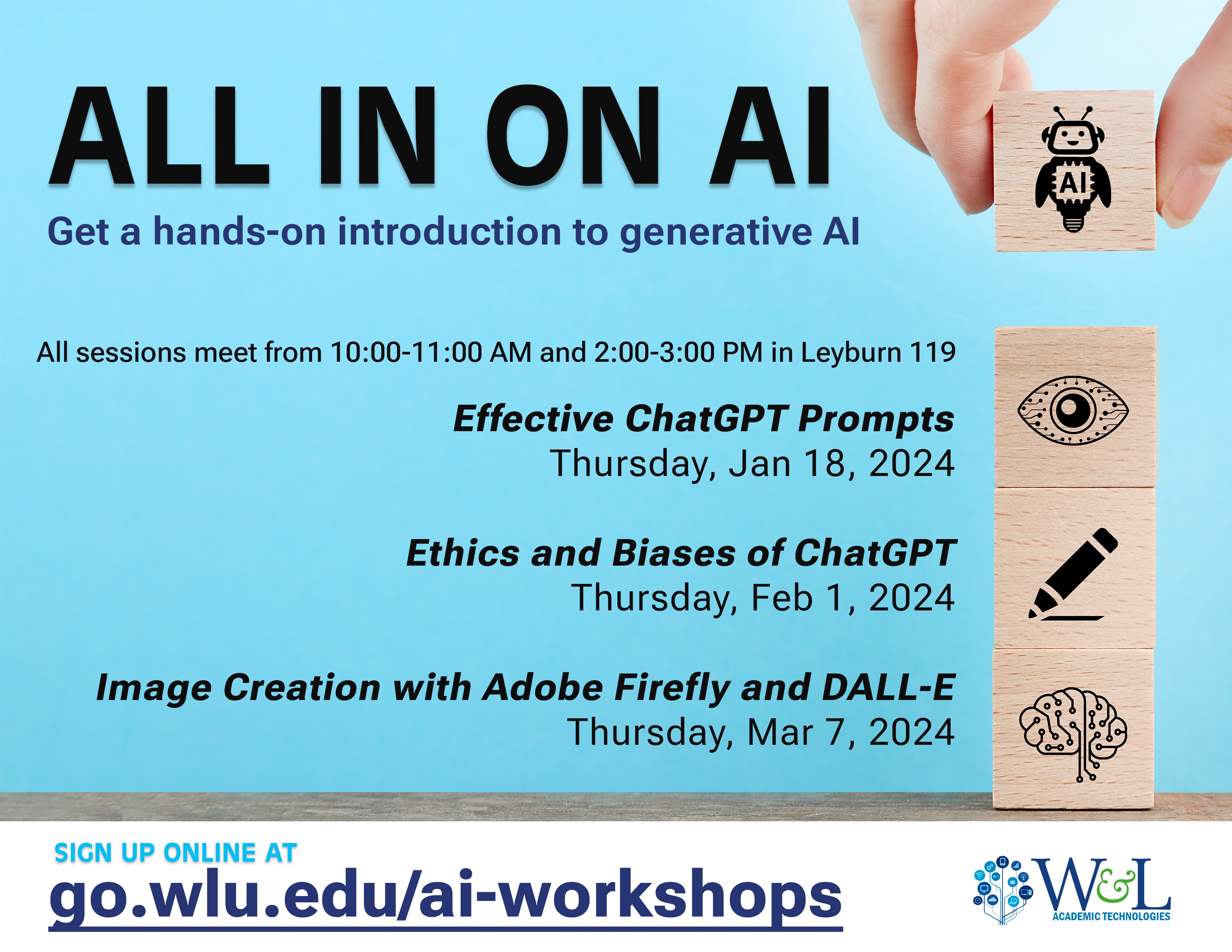
Explore generative AI with Academic Technologies: Announcing our “All in for AI” workshop series!

Effective ChatGPT Prompts -Thursday, Jan 18, 2024
Ethics and Biases of ChatGPT - Thursday, Feb 01, 2024
Image Creation with Adobe Firefly and DALL-E -Thursday, Mar 07, 2024
In the rapidly evolving landscape of technology, generative artificial intelligence stands out as a revolutionary force, reshaping how we interact, create, and think. 

Why Generative AI?

Generative AI, the technology behind tools like ChatGPT and DALL-E, is not just a buzzword; it’s a gateway to endless possibilities. From crafting detailed text responses to creating visually stunning graphics, generative AI is setting new benchmarks in creativity and efficiency.
 
This technology is becoming integral across various sectors, including education, business, and the arts. Thus, it’s crucial for faculty and staff to gain foundational knowledge and hands-on experience in this field so we also prepare our students.
 
  • Effective ChatGPT Prompts
    Thursday, Jan 18, 2024
  • Ethics and Biases of ChatGPT
    Thursday, Feb 01, 2024
  • Image Creation with Adobe Firefly and DALL-E
    Thursday, Mar 07, 2024
All sessions meet from 10-11 am and 2-3 pm in Leyburn 119. Sign up at go.wlu.edu/ai-workshops! Space is limited.
 

AI Online Training Courses through LinkedIn Learning

 The image features two characters engaged with technology on opposite sides of the image. On the left, a man with shoulder-length hair and a beard is sitting cross-legged on the floor, focused on a laptop in front of him. Above him is a graphic of a dark blue analytics dashboard displaying pie charts and bar graphs. On the right, a woman with her hair in a bun is sitting cross-legged on the floor, holding a smartphone. She appears to be interacting with a chatbot, as indicated by a speech bubble with a robot icon and several symbols representing data, gears, and a chatbot head within a thought bubble.

Artificial Intelligence is quickly becoming the cornerstone of innovations. Improve your skills in machine learning; stay current with generative AI; broaden your knowledge in natural language processing, responsible AI, and neural networks.

Check out these new LinkedIn Learning courses:

  • What Is Generative AI?
    In this course, generative AI expert Pinar Seyhan Demirdag covers the basics of generative AI, with topics including what it is, how it works, how to create your own content, different types of models, future predictions, and ethical implications.
  • How to Research and Write Using Generative AI Tools
    You’ve probably already heard about ChatGPT, but did you know it can make you better at your job? Join instructor Dave Birss for a crash course in generative AI and learn how to get started with prompt engineering for ChatGPT and other AI chatbots to upskill as a researcher and a writer.

AI Learning Paths

Dive even deeper and gain skills with curated LinkedIn Learning paths, compiled playlists of related video courses on specific topics. Learning paths include multiple courses by different expert instructors to teach a variety of skills and information.


See all AI Learning Paths

FREE Webinar! AI and Higher Education: Implications for Learning, Curricula, and Institutions

Wednesday, January 10, 2024
 – 

Register now! 

Few innovations have impacted higher education as deeply and swiftly as artificial intelligence has. Initially viewed simply as a threat to academic integrity, it’s now clear that AI presents far greater challenges—and opportunities. Goldman Sachs has estimated that AI may replace 300 million full-time jobs. This rapid workforce evolution is creating demand for an accompanying evolution of higher education to meet new expectations. During this AAC&U webinar, panelists will discuss the many ways higher education will be affected by artificial intelligence, including how AI will influence instruction, curricula, and institutions. They’ll also suggest paths forward that can help you and your institution succeed in this new era.

Panelists
Bryan Alexander

Bryan Alexander
Senior Scholar, Georgetown University

Glida Barabino

Gilda A. Barabino
President and Professor, Olin College of Engineering

William J. McKinney

William J. McKinney
Senior Director of Higher Education Initiatives, Council for Adult and Experiential Learning

Lynn Pasquerella

Lynn Pasquerella
President, AAC&U

Michael Roth

Michael S. Roth
President, Wesleyan University

Moderator
C. Edward Watson

C. Edward Watson
Associate Vice President for Curricular and Pedagogical Innovation and Executive Director for Open Educational Resources and Digital Innovation, AAC&U

Happy Thanksgiving from Academic Technologies!

A multicolored garland that reads "Happy Thanksgiving!"

Pausing to express our heartfelt gratitude to our wonderful Washington and Lee University community …. this season of thanksgiving reminds us of the countless blessings we share as part of this vibrant academic family. Your dedication, creativity, and spirit of collaboration make our campus a place of endless possibilities and profound learning.

We are immensely grateful for the privilege of working alongside such a talented and passionate group of faculty, staff, and students. Your commitment to excellence and your unwavering pursuit of knowledge are the driving forces behind our university’s success.

We sincerely hope you’ll take some time during the break to rest, reflect, and reconnect with loved ones, near or far. May your gatherings be filled with laughter and your tables with abundance.

With thankful hearts,
The ITS Academic Technologies Team

illustration of a group of grateful people saying thank you and expressing thanks